Posts

Another de Lisle Pelican

Image
 This Pelican, the highest award for service, is based on two pages from the de Lisle Psalter, adapted as necessary to portray the presentation of the award to the recipient by the king. This was the second time I have used the de Lisle Psalter for a Pelican Scroll (the original in fact features two "Pelicans in their Piety", symbols of the order).  For the first, see  Two Peerage Scrolls (richardofsalesberie.blogspot.com)

A late-Saxon piece

Image
 This scroll, a high award for service, was done in the style of the late-Saxon "Benedictional of Aethelwold", and attempts to produce a portrait whilst remaining roughly true to the style of the original manuscript. Gouache and leaf gold on Pergamenata.

Return to the Macclesfield Psalter

Image
The Sun and Pearl is a new award, granted to recognise those who add a particular quality of authenticity to the life of the Principality. The Macclesfield Psalter has been the inspiration for many of my scrolls, but this was the first time I attempted to use one of the relatively few pages with four-sided borders as my starting point.  The scroll is a fairly straight copy of the original (though with some restoration, as the original page is rather damaged).  It was personalised by including portraits of the recipient and the presenting Prince and Princess in the initial letter, trying as hard as practically possible to make them consistent with the style of the original... there is also a little in-joke about elephants, and the heraldry has been changed. Gouache on Pergamenata, gold leaf.  

A prize piece

Image
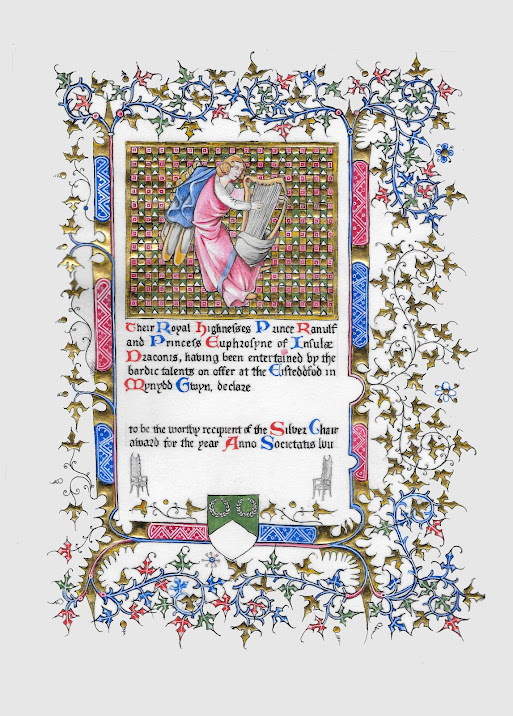
 Another piece produced in a hurry, this was the prize for the performance contest at our local event, the Mnydd Gwyn Eisteddfod.  (It was won by Maredydd ap Gwillim).  Part of the hurry was that I didn't start it because I couldn't get any inspiration.  Then, when visiting the Battle of Tewkesbury re-enactment, my wife and I visited Tewkesbury Abbey, and she pointed out, high above us on a ceiling boss, an angel playing a harp.  It seemed appropriate, so I used it as the basis of a scroll, with a suitable border based on a 14th century manuscript page I found on the internet.  The entire piece was done in three days, just in time for the event.

A Renaissance-Style Portrait.

Image
I was asked to produce this scroll with very little notice, so needed to keep it very simple, without any complex borders or decoration.  I decided to go for the something suggesting a Renaissance portrait, and managed to get hold of people who could supply me with suitable photos of the subject.  The final drawing is a composite, based on photos of Morales, his Renaissance doublet and jerkin, and a detail photo of the blackwork collar in construction.  The hat is entirely fictitious, but a bare head would have looked wrong! I was not present when the scroll was presented, but was fortunate that Libby Cripps photographed the moment, and posted it on Facebook.  

Illuminated Poem: the Flying Monk.

Image
 My fourth illuminated poem.  Having written the last two about an accountant and an insurance salesman, it occurred to me that I had unintentionally written them about the two careers my children had recently started, so it seemed appropriate to see if I could write one about my wife's career.  She is an aircraft engineer, and aircraft were notably absent in the mediaeval period, but I was aware of one... that built by Eilmer of Malmesbury, an 11th century monk mentioned in the histories of William of Malmesbury, a later monk from the same abbey.   I tinkered with the story a bit... the real Eilmer broke his legs in his first flight and never flew again, whereas mine kept trying.  But in the end, my Eilmer was out-classed by flying nuns, in tribute to my wife who has succeeded as a woman in a very male-dominated sphere of work. Stylistically, the inspiration for the illuminations is the "Tres Riches Heures du Duc de Berry"

Cyrillic text

Image
 The two scrolls shown here were a collaboration, in which my role was the calligraphy of the text, which the recipients had requested should be in Old Slavonic style.  The paintings were by Kay Ellis (SCA name, Agatha of Norwich), and the text, was composed by Fiona Scerri and translated into Ukrainian (preferable to Russian at present!) by Lesley McIntee.